Plasma “Fireballs” At CERN May Explain The Universe’s Missing Light
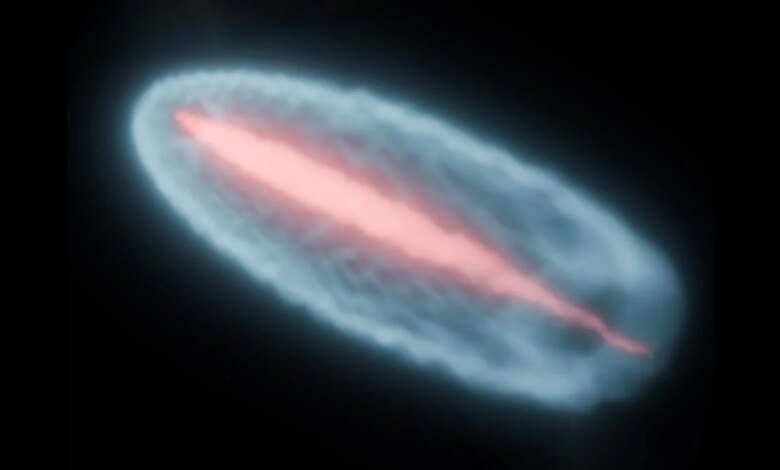
Lab-made cosmic fireballs point to ancient magnetic fields shaping the Universe’s missing light.
A global team of scientists led by theUniversity of Oxfordhas accomplished a world first by producingplasma“fireballs” in a laboratory setting. UsingCERN’s Super Proton Synchrotron accelerator in Geneva, the researchers set out to examine how plasma jets from blazars behave as they travel through space.
Their findings, published inPNASoffer fresh insight into one of astronomy’s long-standing puzzles involving missing gamma rays and the Universe’s elusive magnetic fields.
Blazars and Extreme Gamma-Ray Emission
Blazars are highly active galaxies fueled by supermassive black holes at their centers. These black holes eject narrow beams of particles and radiation that move at nearly the speed of light and, in some cases, point directly toward Earth.
of و the و in – تفاصيل مهمة
The jets release enormous amounts of gamma radiation, reaching energies of several teraelectronvolts (1 TeV = 1012/a trillion eV), which are observed using ground-based telescopes. As these high-energy gamma rays pass through intergalactic space, they collide with faint starlight in the background. This interaction creates cascades of electron-positron pairs.
Scientists expect these particles to interact with the cosmic microwave background and produce lower-energy gamma rays in the GeV range (GeV = 109eV). Yet gamma-ray space observatories such as the Fermi satellite have failed to detect this expected signal. Until now, the cause of this discrepancy has remained unclear.
Two Competing Explanations
One possible explanation is that weak magnetic fields spread between galaxies deflect the electron-positron pairs, sending the resulting gamma rays in directions that miss Earth entirely.
Another idea comes from plasma physics. According to this hypothesis, the particle beams become unstable as they move through the extremely thin matter found in intergalactic space. Small disturbances within the beam could generate electric currents and magnetic fields that amplify the instability and drain energy from the jet.
the و in و to – تفاصيل مهمة
Simulating Blazar Conditions at CERN
To determine which explanation is likely, the researchers carried out an experiment at CERN’s HiRadMat (High-Radiation to Materials) facility. The project was a collaboration between the University of Oxford and the Science and Technology Facilities Council’s (STFC) Central Laser Facility (CLF).
Using the Super Proton Synchrotron, the team created beams of electron-positron pairs and passed them through a meter-long region of plasma. This setup served as a scaled laboratory version of a particle cascade produced by a blazar jet moving through intergalactic plasma.
By carefully measuring the shape of the beam and the magnetic fields associated with it, the scientists were able to directly test whether plasma instabilities could disrupt the beam as it traveled.
Stable Beams Challenge Plasma Instability Theory
The outcome surprised the researchers. Instead of spreading out or breaking apart, the particle beam stayed narrow and almost perfectly parallel. It also showed very little sign of generating its own magnetic fields.
the و of و a – تفاصيل مهمة
When these results are extended to the vast distances involved in astrophysics, they indicate that beam-plasma instabilities are far too weak to account for the missing GeV gamma rays. This strengthens the case for the presence of intergalactic magnetic fields that may have originated in the early Universe.
Linking Experiments and Observations
Lead researcher Professor Gianluca Gregori (Department of Physics, University of Oxford) said: “Our study demonstrates how laboratory experiments can help bridge the gap between theory and observation, enhancing our understanding of astrophysical objects from satellite and ground-based telescopes. It also highlights the importance of collaboration between experimental facilities around the world, especially in breaking new ground in accessing increasingly extreme physical regimes.”
Open Questions About the Early Universe
Despite the progress, the findings raise new challenges. Scientists believe the early Universe was remarkably uniform, which makes the origin of widespread magnetic fields difficult to explain. The researchers suggest that solving this problem may require physics beyond the Standard Model.
Future instruments, including the Cherenkov Telescope Array Observatory (CTAO), are expected to deliver sharper observations that could help test these ideas and refine current theories.
the و of و and – تفاصيل مهمة
Laboratory Astrophysics and Global Collaboration
Co-investigator Professor Bob Bingham (STFC Central Laser Facility and the University of Strathclyde) said:
“These experiments demonstrate how laboratory astrophysics can test theories of the high-energy Universe. By reproducing relativistic plasma conditions in the lab, we can measure processes that shape the evolution of cosmic jets and better understand the origin of magnetic fields in intergalactic space.”
Co-investigator Professor Subir Sarkar (Department of Physics, University of Oxford) said: “It was a lot of fun to be part of an innovative experiment like this that adds a novel dimension to the frontier research being done at CERN – hopefully our striking result will arouse interest in the plasma (astro)physics community to the possibilities for probing fundamental cosmic questions in a terrestrial high energy physics laboratory.”
Reference: “Suppression of pair beam instabilities in a laboratory analogue of blazar pair cascades” by Charles D. Arrowsmith, Francesco Miniati, Pablo J. Bilbao, Pascal Simon, Archie F. A. Bott, Stephane Burger, Hui Chen, Filipe D. Cruz, Tristan Davenne, Anthony Dyson, Ilias Efthymiopoulos, Dustin H. Froula, Alice Goillot, Jon T. Gudmundsson, Dan Haberberger, Jack W. D.
Halliday, Tom Hodge, Brian T. Huffman, Sam Iaquinta, G. Marshall, Brian Reville, Subir Sarkar, Alexander A. Schekochihin, Luis O. Silva, Raspberry Simpson, Vasiliki Stergiou, Raoul M. G. M. Trines, Thibault Vieu, Nikolaos Charitonidis, Robert Bingham and Gianluca Gregori, 7 November 2025,Proceedings of the National Academy of Sciences.
DOI: 10.1073/pnas.2513365122
of و a و the – تفاصيل مهمة
The study involved contributors from the University of Oxford, STFC’s Central Laser Facility (RAL), CERN, the University of Rochester’s Laboratory for Laser Energetics, AWE Aldermaston, Lawrence Liver National Laboratory, the Max Planck Institute for Nuclear Physics, the University of Iceland, and Instituto Superior Técnico in Lisbon.
Never miss a breakthrough: Join the SciTechDaily newsletter.
Follow us on Google and Google News.
Disclaimer: This news article has been republished exactly as it appeared on its original source, without any modification. We do not take any responsibility for its content, which remains solely the responsibility of the original publisher.
Author:University of Oxford
Published on:2026-01-12 22:34:00
Source: scitechdaily.com
Disclaimer: This news article has been republished exactly as it appeared on its original source, without any modification.
We do not take any responsibility for its content, which remains solely the responsibility of the original publisher.
Author: uaetodaynews
Published on: 2026-01-12 21:41:00
Source: uaetodaynews.com