
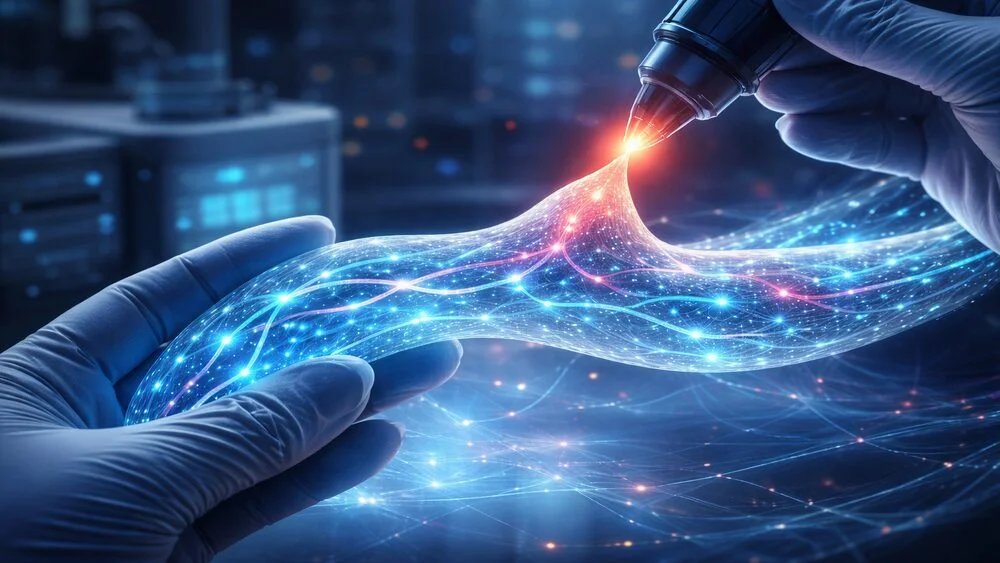
Researchers from China’s Northeast Normal University have unveiled an artificial pain receptor that not only responds to pressure, but is capable of detecting the severity of pain and recovering from damage. The work was published in the journal Advanced Functional Materials and could be an important step in the development of neuroprosthetics and human-machine interfaces.
How does the feeling of pain work?
In the body, nociceptors are responsible for the perception of pain – specialized nerve endings scattered throughout the body. They respond to dangerous mechanical, temperature or chemical influences and transmit signals to the brain, helping to avoid injury.Recreating such a mechanism artificially has been a long-time goal of neural engineers, but until now, solutions have been either too crude or overly complex.
Memristor instead of a nerve
Фото: Advanced Functional Materials
Biological and artificial nociceptive nerves capable of assessing pain.
The new development is based on a memristor, a miniature electronic component that can “remember” the history of current flow. Unlike conventional electronic elements, a memristor changes its conductivity depending on previous influences, making it especially similar to the synapses of the nervous system.
The key effect was quantized conductivity. This means that the current in the device does not change smoothly, but in steps. Thanks to this, the artificial receptor ceased to be a simple switch “there is pain – there is no pain” and began to distinguish between four levels of influence: no pain, mild, moderate and strong – similar to how a person does it.
How does this work
Scientists assembled a system of two types of gelatin films. A denser gel was used as a pressure sensor, and a less concentrated one was used in the memristor part. By connecting them in series, the researchers obtained a flexible “artificial nerve” that responds to mechanical stress.
Tests have shown that the system reliably distinguishes pressure in the range from 9 to 45 kilopascals, comparing it with different intensities of pain experienced by a person. However, the receptor does not “get used” to repeated stimuli, unlike many biological nociceptors.
Self-healing after damage
Фото: Advanced Functional Materials.
A hybrid system combining electronics and nerve fibers monitors muscle contractions and transmits signals back to precisely control movement.
One of the key features of the device was its ability to recover.During the experiments, microscopic cuts up to 50 micrometers wide were made in the gel sensors. After heating to 60 °C for 20 minutes, the damage disappeared and the electrical characteristics returned to the original level.
This property is especially important for prosthetics and flexible electronics, which are inevitably subject to wear and tear in real-world conditions.
To ensure the biocompatibility of the system, the researchers connected an artificial pain sensor to the sciatic nerve of an anesthetized mouse. When the sensor was pressed, it generated electrical signals that caused muscle contraction, a response similar to the natural avoidance reflex.
Why is this necessary?
According to the authors of the work, such bioelectronic systems can radically change the approach to the creation of prostheses, rehabilitation devices and robotics. The ability to distinguish the force of impact and recover from damage makes artificial nociceptors much closer to living tissue than all previous analogues.
Disclaimer: This news article has been republished exactly as it appeared on its original source, without any modification. We do not take any responsibility for its content, which remains solely the responsibility of the original publisher.
Disclaimer: This news article has been republished exactly as it appeared on its original source, without any modification.
We do not take any responsibility for its content, which remains solely the responsibility of the original publisher.
Author: uaetodaynews
Published on: 2026-01-19 23:27:00
Source: uaetodaynews.com